
You set the annual budget in December. €4,000,000. Everyone agreed. Then Q1 happened.
You booked €900,000 against a €1,000,000 plan. Down €100,000. And your budget still says €4,000,000: a number that was a guess in December and is a fiction by April.
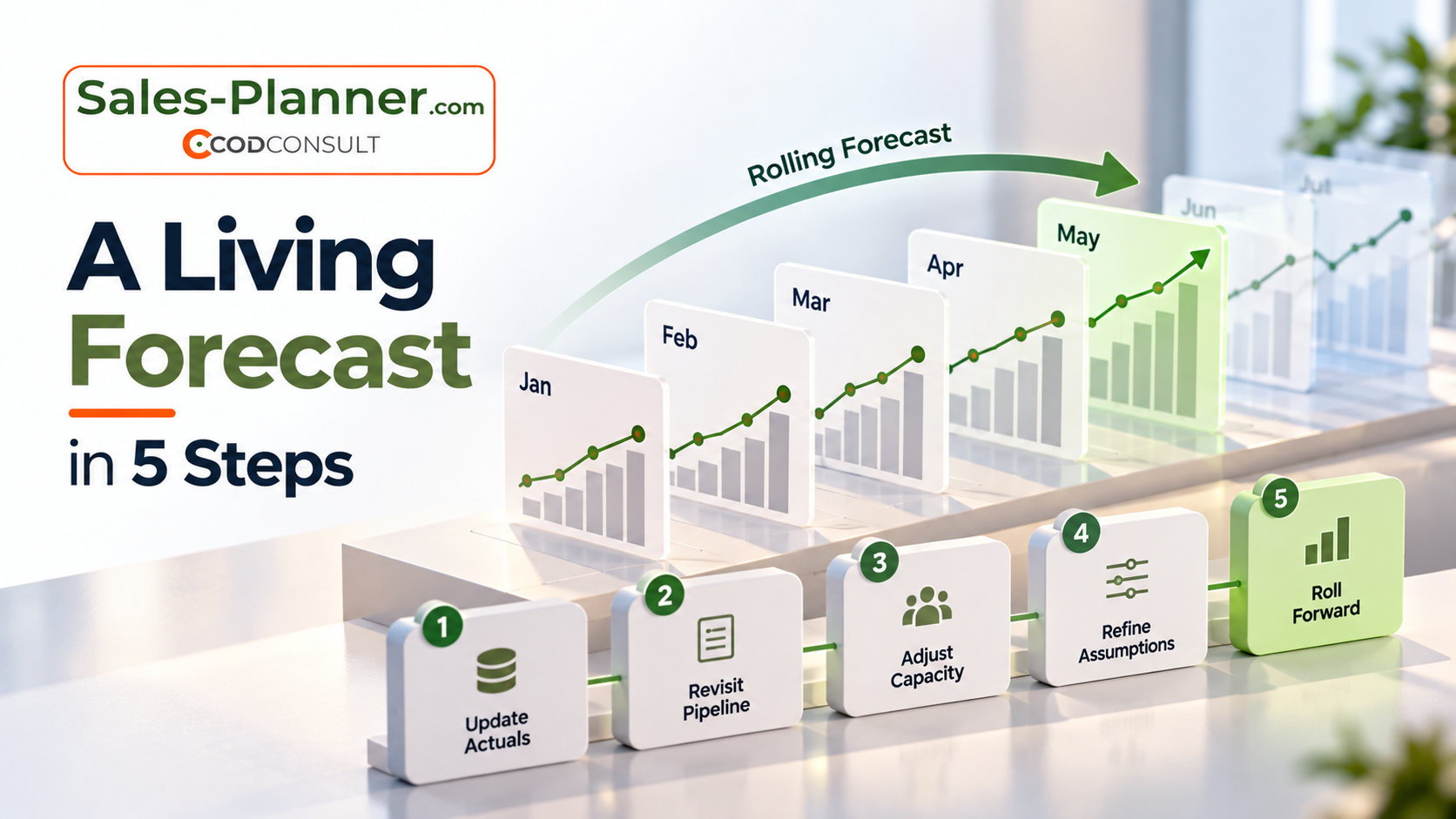
A static forecast is a photograph. A rolling forecast is a live feed. One tells you where you stood; the other tells you where you're heading.
The problem with the static annual number
Hold that €4,000,000 flat and watch what it hides. At your Q1 run-rate of €900,000 a quarter, the next nine months project to about €2,700,000, so your real year lands near €3,600,000, not €4,000,000.
The €400,000 gap didn't appear in December. It was always coming. A rolling forecast shows it in April, when you can still do something. The static budget shows it in January of next year, when you can only explain it.
Step 1: Fix the horizon, not the finish line
A rolling forecast always looks 12 months forward. When April closes, you drop it and add next April. The window never shrinks to “three months left to save the year.” You're always planning a full year, from wherever you stand.
Step 2: Build on drivers, not last year plus 10%
“Last year plus 10%” is a wish, not a forecast. Build from the drivers that actually move the number: open pipeline, win rate, average deal size, sales-cycle length, and rep ramp. Change a driver, and the forecast moves with it: that's the point.
Step 3: Re-forecast on a fixed cadence
Monthly for the number, quarterly for the assumptions. Pick the dates and hold them. A forecast you update only when someone panics isn't rolling: it's reactive. A tool built for rolling forecasts re-casts the remaining months automatically each time actuals land, so the cadence runs itself.
Step 4: Measure how wrong you were
Forecasting without checking accuracy is just guessing with confidence. The math is simple: if you forecast €1,000,000 and booked €900,000, your error is €100,000, or 10%. Track that every month. A team that knows it runs 10% optimistic can correct for it; a team that never measures repeats the miss forever.
Step 5: Make it one living number
If the rep's forecast, the manager's forecast, and the board's forecast are three different files, you don't have a rolling forecast: you have an argument. Keep it in one place, updated live, visible to everyone. Good sales planning software keeps that single number current without a monthly fire drill.
FAQ
What's the difference between a rolling forecast and a budget?
A budget is set once and held fixed. A rolling forecast is re-cast on a schedule and always looks a fixed horizon ahead, usually 12 months.
How often should I re-forecast?
Monthly for the numbers, quarterly for the underlying assumptions. More often than that is noise; less often lets gaps hide.
Doesn't rolling forecasting take more work?
Only by hand. When the forecast re-casts from live pipeline and actuals automatically, it takes less time than rebuilding a spreadsheet every quarter.
What makes a rolling forecast accurate?
Driver-based inputs, a consistent cadence, and measuring forecast error every month so you can correct a standing bias.
Stop steering the year with a number you set before it started. Sales Planner turns your pipeline and actuals into a rolling forecast that re-casts every month, measures its own accuracy, and stays one shared number across the team. Start your free 2-week trial of Sales Planner and forecast forward, not backward.
Go from reading to doing — in 2 weeks.
Try the planning tool for free, or talk to Andreas about your specific situation.
The playbooks Andreas only shares with paying clients — straight to your inbox.
Four letters a year. Each one packed with frameworks, numbers and lessons from live enterprise engagements. No marketing fluff, no generic sales coaching.
- 1 deep-dive framework
Ready to use — from pipeline reviews to quota logic.
- 1 live lesson
What worked (or didn't) this week on a 7-figure engagement.
- 1 RevOps tool
One we actually pay for — with an honest verdict.
- No spam, ever
- 1-click unsubscribe
- GDPR-compliant · EU-hosted
Andreas writes about B2B sales, RevOps, and scaling enterprise sales teams drawing from 20 years of experience.