
Let's be honest. Your enterprise does not need another lengthy strategy session or a slide deck full of vague growth words. It needs clean numbers, realistic capacities, and an operating model that connects boardroom expectations with reality on the ground.
In Enterprise Performance Management (EPM), the choice between top-down and bottom-up approach is usually treated like a philosophical debate. It is not. It is an engineering problem. If you've sat through a planning cycle, you already know the pain. Finance hands down a revenue growth target. Sales builds a forecast from real accounts. The two numbers don't match. Someone has to explain the gap in a room full of people who don't like surprises. I've seen this fight in nearly every enterprise I've worked with, and it never gets solved by a slide deck. It gets solved by math and process. Let me show you how!
What Top-Down Planning Actually Is
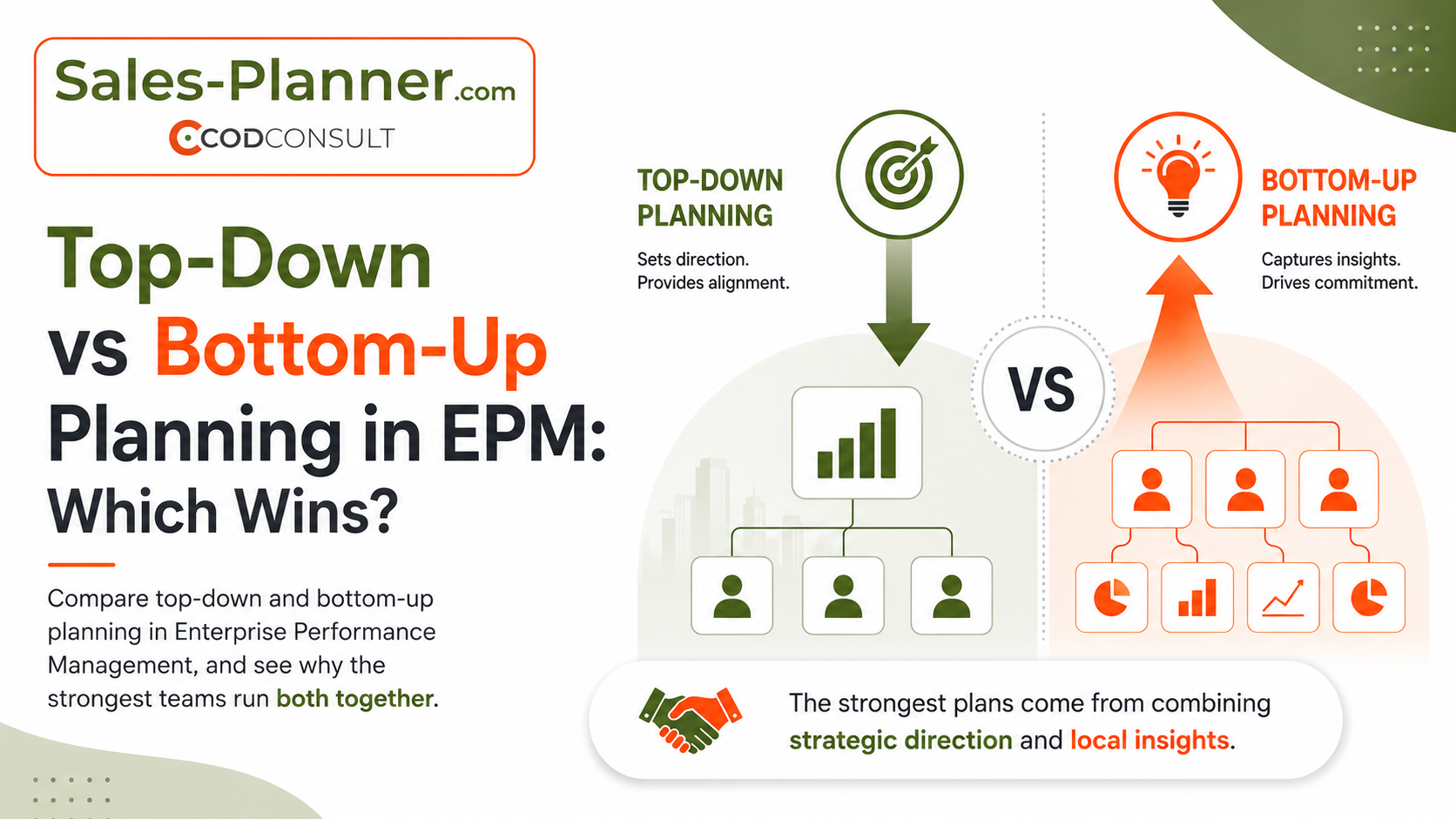
In top-down planning, senior leadership sets the goal first. Revenue target, growth rate, budget ceiling, decided at the top, then handed down to departments to work out the details.
This is fast. One meeting, one number, done. It also keeps every department pointed at the same company goal, which matters when you have twenty regions and no time to negotiate with each one.
The problem is simple: the number often comes from a market view, not a ground view. Leadership sees the industry is growing 15%, so they set a 15% target. But they don't see that three of your top reps just left, or that a key account is cutting spend. The target looks clean on paper and breaks in the field.
What Does Bottom-Up Planning Mean
Bottom-up planning flips the order. Reps and managers build their numbers first, based on real pipeline, real accounts, and real capacity. These numbers roll up through the hierarchy until you get a company total.
This gives you accuracy. The people closest to the customer are the ones setting the target, so the number reflects what can actually be sold. It also builds buy-in; a rep who set their own quota fights harder for it than one who was handed a number from above.
But bottom-up has its own weakness: it's slow, and it's often too safe. Reps under-promise to protect themselves. Add up two hundred cautious numbers, and you get a company forecast that's lower than what leadership needs to hit its own commitments to the board.
The Math That Exposes the Gap
Here's where I stop selling you a vibe and show you the number.
Say leadership sets a top-down target of €50 million for the year, based on 15% market growth.
Now the field builds its bottom-up plan. 200 reps, each committing to what they can realistically close. Average commitment: €220,000 per rep.
200 × €220,000 = €44 million
That's a €6 million gap, 12% of the total target, sitting between the boardroom and the field on day one of the planning cycle. This is not a rare case. This is the normal outcome when you run top-down and bottom-up as two separate exercises instead of one connected process.
Companies that don't reconcile this gap don't get a plan. They get two plans pretending to be one, and the real number shows up as a miss in Q3.
Why the Mixed Top-Down and Bottom-Up Approach Wins
The strongest planning teams don't pick a side in the top-down vs bottom-up planning debate. They run both, at the same time, against the same data.
Leadership sets the direction: growth rate, budget limits, strategic priorities. The field supplies the detail: account potential, rep capacity, territory realities. The two meet in the middle, and the €6 million gap becomes a conversation, not a surprise. Maybe you close it by adjusting territories. Maybe you add headcount. Maybe the top-down number was wrong and needs to move. Either way, you decide with numbers, not guesswork.
This is the core of the top-down and bottom-up strategies most enterprise finance and sales operations teams now run side by side, and it's why the phrase "top-down and bottom-up approach" shows up in almost every serious EPM playbook today.
Where Planning Software Fits In
Running this by spreadsheet is where most companies fail. Spreadsheets can hold one version of the truth, not two versions being reconciled in real time. By the time you've manually rolled up 200 rep forecasts and compared them to the executive target, the quarter has moved on.
Most modern sales planning software solves this by connecting both directions in one system. Leadership sets targets, the field builds their plan against real account and territory data, and the platform shows the gap the moment it appears, not at quarter-end. Scenario modelling lets you test what closing that €6 million gap actually costs in headcount or territory changes, before you commit to a number you can't defend in the boardroom.
See the Gap in Your Own Numbers
Top-down gives you speed and direction. Bottom-up gives you accuracy and buy-in. Used alone, each one produces a plan with a hole in it. When top-down and bottom-up approaches are used together, backed by the right software, they produce a number everyone in the building can stand behind, because it was built from both ends and met in the middle, with the math to prove it.
If you are still running your enterprise growth plans out of a fragile web of unlinked Excel files, you are burning money on hidden execution gaps. Let's fix that. Run your real numbers through a Sales Planner's model and see your gap, in euros, in under 15 minutes. Speak directly with Andreas Dorsch to map your enterprise maturity level and build a realistic, data-driven growth path.
Go from reading to doing — in 2 weeks.
Try the planning tool for free, or talk to Andreas about your specific situation.
The playbooks Andreas only shares with paying clients — straight to your inbox.
Four letters a year. Each one packed with frameworks, numbers and lessons from live enterprise engagements. No marketing fluff, no generic sales coaching.
- 1 deep-dive framework
Ready to use — from pipeline reviews to quota logic.
- 1 live lesson
What worked (or didn't) this week on a 7-figure engagement.
- 1 RevOps tool
One we actually pay for — with an honest verdict.
- No spam, ever
- 1-click unsubscribe
- GDPR-compliant · EU-hosted
Andreas writes about B2B sales, RevOps, and scaling enterprise sales teams drawing from 20 years of experience.