
If your business treats the finance department like a group of historical bookkeepers who only look at past bills, you are missing the point. Traditional accounting is like looking out your back window to check where you just drove. It keeps you compliant, but it does not steer the car.
To steer the car, you need to understand what is FP&A actually.
Financial Planning and Analysis (FP&A) is the forward-looking engine of corporate finance. Instead of asking "What did we spend last month?" FP&A asks, "Given what we spent, where will our cash balance sit in twelve months if sales drop by 15%?"
Now let's show the math behind it, because a definition without proof is just marketing.
What is FP&A In Business And Finance
Every company has two kinds of finance work. One looks backwards; that's accounting. It records what happened last month, last quarter, last year. The other looks forward; that's FP&A. It asks: based on what happened, what should we do next?
So when someone asks "what is FP&A in finance," the honest answer is this: it's the bridge between your financial data and your business strategy. Accounting closes the books. FP&A opens the conversation about what those books mean for the next twelve months.
The FPA in business gets clearer once you see what the team actually delivers:
- Budgets: how much money each team gets, and why - Forecasts: updated, rolling predictions of revenue, cost, and cash - Variance analysis: the gap between plan and actual, explained in plain terms - Scenario models: what happens if sales drop 10%, or hiring doubles
None of this is guesswork dressed up as insight. It's arithmetic, applied on time, to the right question.
The Four Core Pillars of Modern FP&A
A functional FP&A unit does not spend its days formatting spreadsheets for fun. It operates across four distinct, repeatable pillars to keep your business stable.
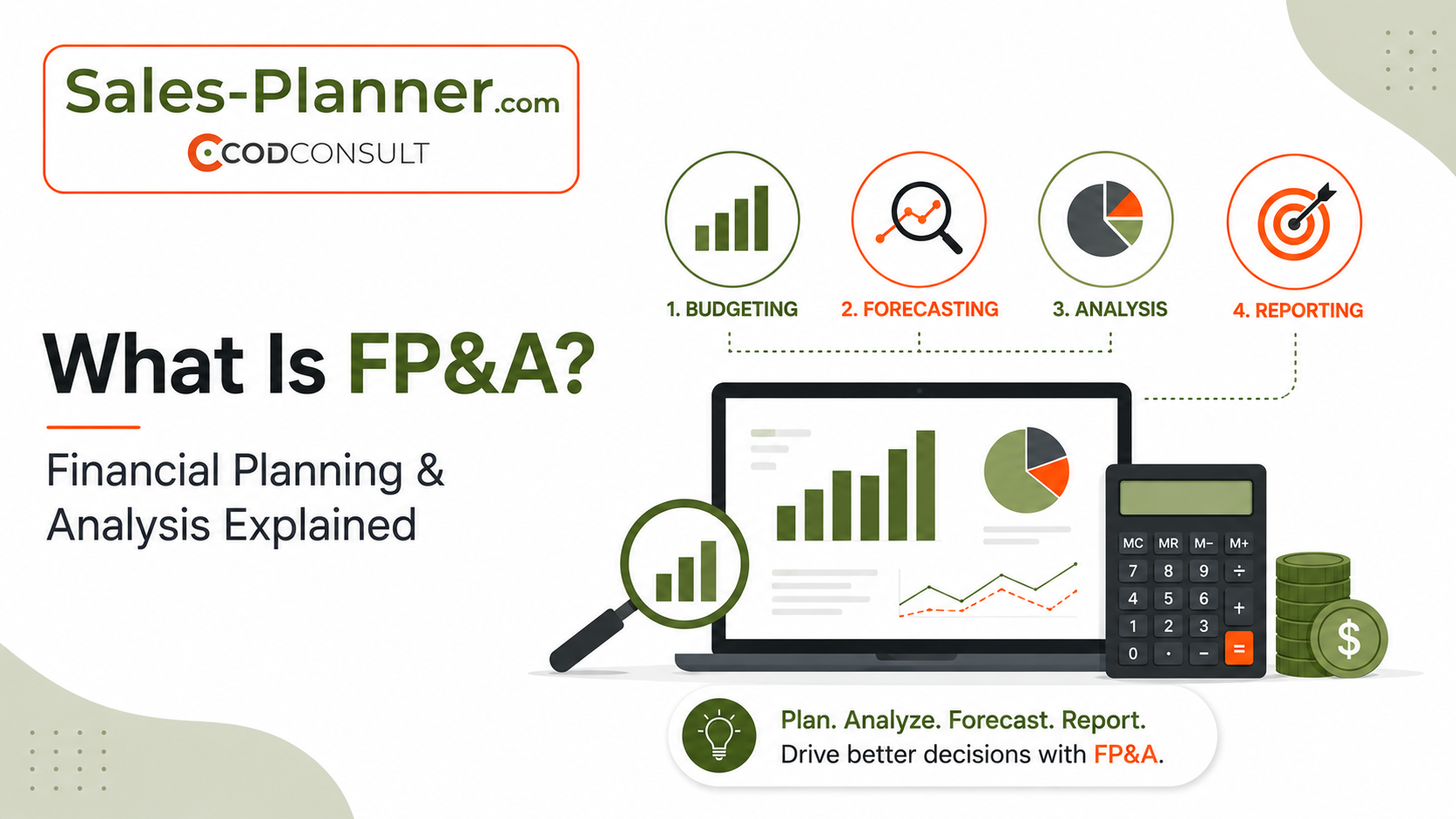
Strip away the jargon and FP&A runs on four repeatable steps:
1. Collect the Data
Revenue numbers, headcount cost, marketing spend, and pipeline are pulled from your ERP, CRM, and spreadsheets, then checked for accuracy. Bad input, bad output. This step is boring, and it's the one most teams rush. Don't.
2. Build the forecast
Take the trend, apply the drivers (price, volume, churn, seasonality), and project forward. A good forecast isn't a guess; it's a formula with assumptions you can defend in a meeting.
3. Set the budget
Revenue plan minus required investment equals what each department gets. If sales expects €2M in new revenue and your cost-to-acquire is €400 per customer at a 20% close rate, marketing needs a spend number that supports that math, not a number pulled from last year plus 10%.
4. Report and adjust
Compare actual results to the plan every month. If revenue is 8% under forecast, FP&A doesn't just flag it; it tells you why, and what lever to pull: pricing, headcount, spend, or timeline.
That loop of plan, track, explain, adjust is the entire discipline. Everything else is detail.
Accounting vs. FP&A: Show Me the Math
To understand full FPA meaning in business, you must look at how it differs from traditional accounting. The division comes down to time horizons and math.
Accounting (Past) Records Transactions ───► [ Present Day ] ───► FP&A (Future) Builds Projections
Imagine a SaaS business with the following basic financial profile:
- Current Monthly Recurring Revenue (MRR): €100,000 - Monthly Churn Rate: 2% - New Monthly ARR Growth Target: 20% year-over-year
An accountant will look at the ledger at the end of the month, verify that €100,000 hit the bank, account for expenses, and close the books.
An FP&A analyst takes that same data and builds a dynamic forecasting model to calculate future cash runway. The math looks like this:
- Next Month Target MRR = Current MRR × (1 − Churn) + New MRR - Next Month Target MRR = €100,000 × (0.98) + New Bookings Target
If the executive team wants to double headcount next quarter, FP&A maps this formula out over 12, 24, and 36 months. They match it against your Customer Acquisition Cost (CAC) and Customer Lifetime Value (CLV). They show you exactly which month your bank account hits zero if your sales team misses their targets.
Accounting tells you where you stood. FP&A tells you where you will break.
Why Modern Business Demands Strategic FP&A
Operating without a dedicated financial planning framework is a major risk. Gut-check decisions do not scale. Here is why high-growth companies treat FP&A as a non-negotiable partner:
- Predictable Cash Flow Management: You can have great sales numbers and still go bankrupt if your cash collection cycles do not match your accounts payable schedules. FP&A maps cash inflows and outflows to protect your working capital. - Elimination of Waste: By enforcing continuous budgeting cycles (like zero-based budgeting), companies justify every dollar spent each period rather than automatically rolling over old, inefficient budgets. - Faster Executive Decisions: When a competitor shifts prices or an unexpected economic downturn hits, leaders cannot wait three weeks for a manual report. A structured FP&A system gives the executive board instant, reliable answers to complex "what-if" questions.
Fix Your Forward Planning Today
The answer to what is FP&A, it builds an accurate, driver-based simulation. A forecast built once a year and never touched again isn't a plan; it's a guess with a deadline. If your budgeting still lives in three disconnected spreadsheets and a monthly scramble to explain variance, you don't have an FP&A process. You have a fire drill.
At Sales-Planner, we build the clean, automated financial models and strategic forecasting infrastructure that high-growth businesses require to scale safely. We eliminate data chaos, optimise your resource allocation, and give your leadership team clear financial visibility.
Schedule a direct architecture call with our corporate finance specialists at Sales-Planner today, and let's map out a predictable financial model for your business.
Go from reading to doing — in 2 weeks.
Try the planning tool for free, or talk to Andreas about your specific situation.
The playbooks Andreas only shares with paying clients — straight to your inbox.
Four letters a year. Each one packed with frameworks, numbers and lessons from live enterprise engagements. No marketing fluff, no generic sales coaching.
- 1 deep-dive framework
Ready to use — from pipeline reviews to quota logic.
- 1 live lesson
What worked (or didn't) this week on a 7-figure engagement.
- 1 RevOps tool
One we actually pay for — with an honest verdict.
- No spam, ever
- 1-click unsubscribe
- GDPR-compliant · EU-hosted
Andreas writes about B2B sales, RevOps, and scaling enterprise sales teams drawing from 20 years of experience.